Six Figures in the Dark: Inside the High-Stakes Robot Gaming Circuits Nobody's Heard Of
The bracket is posted at 11 PM on a Tuesday in a Discord server with 340 members. By Wednesday morning, $50,000 is on the line. By Friday, it'll be gone — transferred through PayPal, Venmo, and at least one cryptocurrency wallet — to a player most of the gaming world has never heard of, competing in a game most of the gaming world has never played.
Welcome to the shadow esports circuit. Population: not many. Prize pools: absurdly large relative to the audience. Skill ceiling: genuinely terrifying.
This is where competitive robot gaming actually lives.
The Arithmetic Doesn't Make Sense (Until It Does)
Let's establish the basic weirdness of this scene before we go any further, because it's important: we are talking about games with active player counts in the low thousands — sometimes the low hundreds for the most niche titles — sustaining prize pools that rival mid-tier mainstream esports events.
How? The answer is community concentration.
In a game with ten million players, the competitive ecosystem has to be built from scratch. Organizations need to invest in infrastructure, broadcast production, talent scouting, all of it. The audience is broad but shallow — most of those ten million players are casuals who'll watch one stream and move on.
In a game with eight thousand players, the competitive community is the entire community. Everyone who's still playing six months after launch is probably running brackets or watching them. The audience is tiny but pathologically engaged. Sponsorship dollars don't scale with audience size the way you'd expect when every single viewer is a potential customer for the hardware, peripherals, and game-adjacent products being advertised.
"It's like the difference between a billboard on the highway and a table at a gun show," says one tournament organizer who runs a competitive circuit for a mech sim that peaked at around 12,000 concurrent players. "The highway has more eyeballs. The gun show has better customers."
What These Scenes Actually Look Like
The venues range from genuinely grim to surprisingly well-resourced, often within the same circuit.
Some events are exactly what you'd picture: folding tables in someone's finished basement, extension cords running under doorways, a whiteboard bracket that gets updated with a dry-erase marker. Entry fees are cash-only. The snack situation is whatever someone grabbed from Costco.
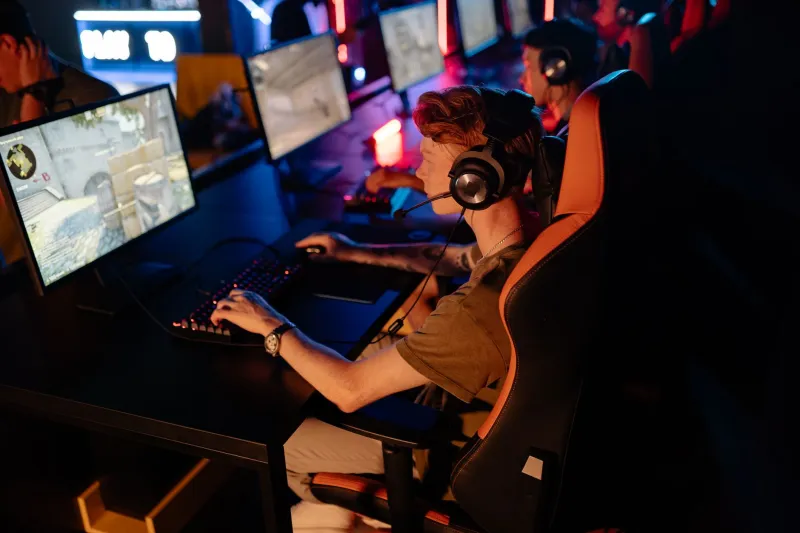
Others have leveled up into rented warehouse space — the kind of anonymous industrial square footage that goes for cheap on weekends in cities like Detroit, Pittsburgh, and Phoenix, where the robot gaming community has particularly dense pockets. These events have actual PA systems, proper monitor setups, and occasionally a production crew running a stream to an audience of a few hundred people who are deeply, almost aggressively invested in the outcome.
The Discord-native circuits are their own beast entirely. These are fully online competitive structures — seasonal leagues, weekly brackets, monthly majors — that exist entirely within private servers. Prize pools are assembled through entry fees, community donations, and sponsorships from the kinds of brands that can't get near mainstream esports: indie hardware makers, small gaming supplement companies, the occasional custom PC builder who found the community through a Reddit thread three years ago.
The Players Grinding in Obscurity
Here's what makes this scene genuinely strange: the skill level is real.
Spend any time watching high-level play in these circuits and the technical execution is legitimately impressive. These are players who have logged thousands of hours into games with steep mechanical curves, who have developed and refined competitive metas in communities small enough that everyone knows everyone, who have innovated strategies that — because the player base is so insular — haven't been countered yet.
Several players in these circuits have tried to cross over into mainstream competitive gaming and reported that the transition was jarring not because the mainstream games were harder, but because the skill expression was different. The niche robot game circuits tend to reward a kind of systematic, almost scientific mastery — deep system exploitation, frame-perfect mechanical execution — that doesn't always translate cleanly to more casual-accessible titles.
"I went to an open qualifier for a mainstream FPS last year just to see where I stood," says one competitor who goes by the handle Ferroflux and has won multiple championships in a competitive robot sim with roughly 6,000 active players. "Made top 16. Which was fine. But the game felt shallow to me. Like playing checkers after years of chess. I came back home."
Why They Stay in the Dark
The question that hangs over all of this is: why don't these players and these scenes push for mainstream recognition? The prize money is there. The skill is demonstrably there. What's keeping this underground?
The answers are more complicated than they first appear.
Some of it is simple economics. Mainstream esports exposure requires broadcast infrastructure, which requires investment, which requires the kind of organizational interest that only arrives when audience numbers justify it. The circuit organizers running these events are often doing it as a passion project on top of day jobs. They don't have the bandwidth to also build a media company.
Some of it is cultural. These communities developed in deliberate opposition to the mainstream gaming industry. The insularity isn't just an accident of small numbers — it's partly intentional. The people inside these circuits like that outsiders don't understand what they're watching. There's status in difficulty. There's identity in obscurity.
And some of it, honestly, is that the mainstream esports industry hasn't come knocking. A few organizers mentioned approaches from larger esports organizations that went nowhere when the conversation turned to audience size.
"They want the numbers first," one organizer says. "But you can't get the numbers without the infrastructure, and you can't get the infrastructure without the investment. It's a catch-22 that keeps us exactly where we are."
For now, the brackets keep getting posted at 11 PM on Tuesday nights. The prize money keeps changing hands. And the most technically skilled robot game players in the country keep grinding in the dark, getting better at something most people don't know exists.
Devil Robots knows. We'll keep watching.