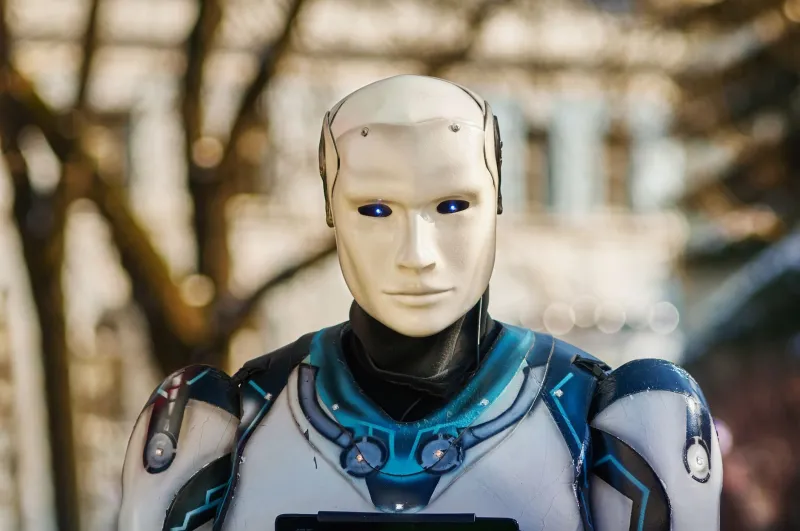
Broken on Purpose: Why Stuttering Robot Animations Hit Harder Than Smooth Ones
Here's something that'll mess with your head: the most unsettling robot encounter you've ever had in a game probably wasn't running at a locked 60fps.
It was choppy. It hitched. The enemy's head turned a half-beat too late, or its walk cycle dropped a frame at exactly the wrong moment, and suddenly your brain went into full alarm mode. Not because the game was broken — but because something in your nervous system decided that wrong motion is way more threatening than no motion or perfect motion.
Welcome to the uncanny valley, speedrun edition.
The Frame Drop That Launched a Thousand Nightmares
Most players assume technical polish equals better immersion. Smooth framerates, tight animation blending, zero hitching — that's the goal, right? Game studios spend millions chasing it. But there's a growing body of evidence, backed by both neuroscience research and anecdotal reports from competitive players, suggesting that controlled imperfection in robot enemy movement can trigger threat responses that flawless animation simply cannot.
Dr. Priya Mehta, a perception researcher at a mid-sized university in the Pacific Northwest who consults informally with indie studios, puts it bluntly: "Your visual cortex is wired to detect biological motion. It's ancient hardware. When something moves almost-but-not-quite like a living thing, the brain doesn't shrug it off — it escalates. A stutter in a humanoid robot's gait pattern can read as predatory behavior, even when intellectually you know it's a polygon mesh on a screen."
That escalation is the whole ballgame. It's not about broken code. It's about what broken code communicates to the oldest parts of your brain.
Designers Who Broke Things Deliberately
Not every stutter is an accident. Some developers figured this out early and started engineering imperfection directly into their robot enemy behavior trees.
Marcus Vell, a combat designer who worked on two mid-tier sci-fi shooters before going indie, described his approach during a Discord AMA that got screenshotted and passed around extensively in game dev circles last year. "We had this humanoid security bot that tested totally flat emotionally," he said. "Players weren't scared of it. So we introduced what we called 'perception lag' — a randomized 80-to-140 millisecond delay on head-tracking animations specifically. It didn't affect gameplay at all. But playtester fear ratings went through the roof."
The bot wasn't actually slower. It wasn't actually more dangerous. It just looked like it was processing you differently, recalculating, deciding something. And that gap — that little window of apparent cognition — made players deeply uncomfortable in a way that smooth, predictable tracking never did.
Other designers have taken the opposite approach: deliberately dropping animation frames during specific attack wind-ups so the motion reads as violent and unpredictable rather than telegraphed and safe. The result is enemies that feel genuinely threatening even when veteran players know their attack patterns cold.
Speedrunners as Accidental Psychologists
Here's where it gets really interesting. The speedrunning community, in its relentless mission to break every game ever made, has accidentally become one of the most detailed archives of what robot enemy imperfection actually does to human cognition under pressure.
Talk to any experienced runner who's put serious time into games with humanoid robot enemies and they'll tell you about specific rooms, specific encounters, specific frame-timing windows where the game does something weird and their run falls apart — not because they made a mechanical mistake, but because the visual wrongness of a stuttered animation pulled them out of flow state.
Jamila Osei, a mid-level runner in the survival horror community who streams under the handle @circuit_scar, described one such encounter during a recent stream breakdown video. "There's this one bot in [a game she declined to name for copyright reasons] that has a known frame skip on its turn animation at a specific camera angle. Every single time I hit that room, even knowing it's coming, my heart rate spikes. I've clocked it on my monitor. It goes up like 12 beats per minute. For a polygon. Because it moves wrong for one frame."
She's started using that response intentionally — treating the moment of spike as a reset cue, a way to snap back into focus rather than letting the adrenaline cascade into panic. "It's like the game's doing me a favor at this point," she laughed. "Free stimulant, courtesy of a frame budget issue from 2019."
The Neuroscience Underneath
The mechanism Dr. Mehta and others point to is something called the motion coherence threshold — basically, the point at which your brain decides whether a moving object is biological or mechanical. Smooth, predictable motion gets categorized quickly and filed away. Irregular motion with biological shape but mechanical timing triggers extended threat assessment.
"The brain doesn't like ambiguous categories," Mehta explains. "Is this thing alive? Is it malfunctioning? Is it about to do something I can't predict? That uncertainty has a metabolic cost. It keeps your threat-detection system running hot."
For robot enemies specifically, this creates a fascinating design paradox. The more lifelike you make the base animation, the more disruptive a single missed frame becomes. A blocky, obviously-mechanical enemy can stutter all day and your brain doesn't care — it already filed it under "not biological." But a humanoid robot with fluid idle animations and realistic weight distribution? One frame drop on its head turn and you're suddenly in full threat-assessment mode, heart rate climbing, focus narrowing.
The uncanny valley isn't just about appearance anymore. It's about motion timing. And framerates are the new frontier.
What This Means for the Next Generation of Robot Enemies
As games push toward higher fidelity and developers chase 120fps on current-gen hardware, there's a real risk of accidentally engineering the threat response out of robot enemies. Perfectly smooth is perfectly predictable. Perfectly predictable is perfectly safe. And perfectly safe robot enemies are, frankly, boring.
The smarter studios are already building deliberate imperfection back in. Procedurally generated micro-stutters. AI behavior trees with randomized processing delays. Animation systems that intentionally desync from audio cues by small, variable margins.
It's counterintuitive as hell. You spend years and millions getting your tech to run clean, then you deliberately inject noise back into the signal. But the psychology is sound, the player data backs it up, and the speedrunning community has been running unintentional experiments on this for years.
The robots that haunt you aren't the ones that move perfectly.
They're the ones that move almost perfectly — and then don't.
That's not a bug. Increasingly, it's the whole point.